Technical stuff
After finishing ReGenesis, I jettisoned a lot of my live rig (some of which was definitely getting a bit long in the tooth) and bought some shiny new bits and pieces, much of which were instrumental (sorry) in making Lost and Found. Here's a rough guide to what went into the mix:
The computer: A Mac Mini M4. A scarily powerful little computer running Logic Pro Xl.
Logic is the DAW I've used for donkey's years, starting out with version 9 if I'm not mistaken. Since then it has improved, and become increasingly powerful and flexible. However, the main reason I've stuck with it and not moved to the many excellent alternatives is because I'm used to it. It does everything I want and I'd only go to another DAW if there was something it didn't do that I felt I really needed.
Logic, more than any other DAW, comes with an ever expanding library of sounds and virtual instruments, of varying quality admittedly. However, on Lost and Found I used their pianos and electric pianos, the Hammond Organ, some mellotron sounds (in addition to my Mellotron M4000D before I sold it) and some other bits and pieces. I also use mostly Logic when it comes to reverbs, echos, compression and other effects.
I also used a selection of soft synths and tools - chief amongst them was the mighty Omnisphere 3. This extraordinay synth has a library of over 40,000 sounds - and that's before programming your own!
So the computer remains at the heart of. my music making and I'm very pleased with the setup I've got.
In addition, I used the following:
Roland Fantom 7 EX. This mighty engine of sound is the flagship of the Roland range, at the time of writing at least. It's an increadible instrument, once again providing once again a ludicrously large library of sounds plus multiple ways to create your own including:
A variety of orchestral sounds - I used the orchestral sounds from the Roland as much as those I had on the computer - strings, brass, various woodwind, percussion - all sorts of stuff.
A fully featured Roland Jupiter 8 using the latest virual analogue technology. The ENTIRE Roland Jupiter 8 interface is available to create sounds and I used this a lot, as well as the equally impressive SH101 on board as well.
A Behringer Pro One. This is a completely analogue recreation of the Sequential Circuits Pro One. I have bought and sold many, many keyboards over the years and the only one I really regretted selling was my trusty Pro One which I owned for over thirty years. The Behringer version is a stunning clone, both sound and feel wise - and I should know! Since then I've bought another 'boutique' synth - a Roland JU-06 which with equally stunning precision recreats the Juno 60, another great synth from the Eighties brought back to life. I used the Pro One for several lead and bass sounds on 'Lost and Found'.
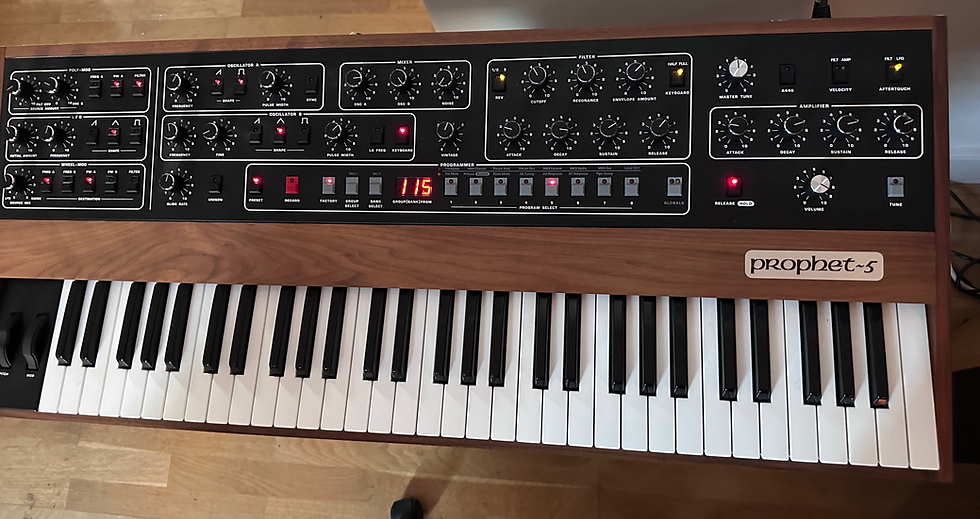
Prophet Five - Rev 4. Dave Smith created the Prophet Five and for my money it's the greatest analogue synth of all time. I used to own a Rev 2 but not long before he died, Dave Smith created a final version of this classic synth - the Rev 4. It's a a beautiful thing and got plenty of use on Lost and Found.
Other outboard stuff - Yamaha HS7 speakers, a Rode USB microphone - we do have posher mics but this as a terrific sound wise and so easy to use within a digital setup. When using it with the Mac, Logic detects it and immediately offers many vocal processing options of EQ, Compression etc, some of which I used or at least started with before tweaking. My ancient (but silent) old Mackie Mixer for all real instruments', and a PreSonus USB interface. That's about it!